Early decisions determine whether a project works — financially, operationally, and spatially.
Yet feasibility studies are often slow, manual, and dependent on a limited number of options explored under time pressure.
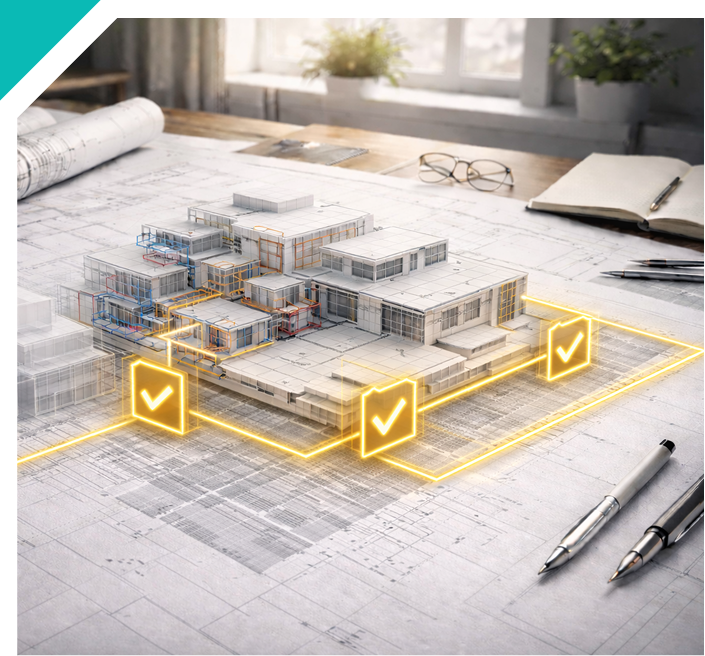
We approach feasibility as an iterative evaluation process rather than a single proposal.
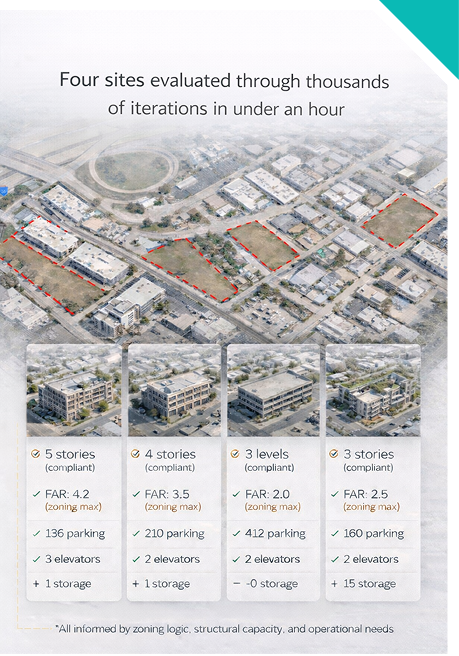
Our workflows allow multiple building layouts, parking strategies, circulation patterns, and code constraints to be evaluated in parallel — providing measurable feedback while options are still flexible.
What this enables:
Rapid comparison of multiple site strategies instead of one assumed scheme
Early visibility into parking yield, unit count, and efficiency ratios
Faster alignment between ownership, development, and design teams
Decisions supported by measurable outcomes rather than intuition alone
The goal is not faster drawings —
it is earlier confidence.Master Planning
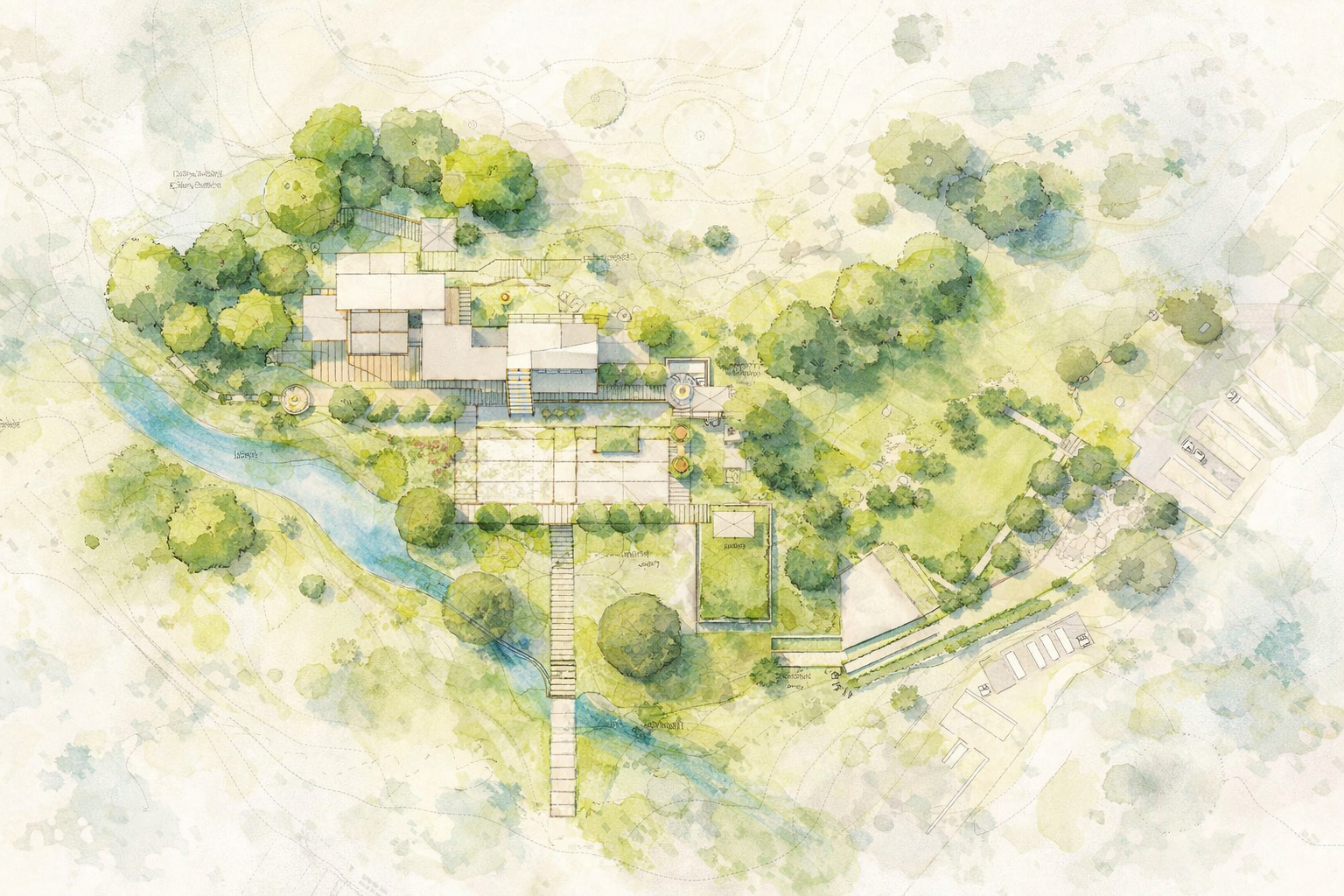
Master planning requires balancing long-term vision with immediate feasibility.
Many plans fail later not because the concept was wrong, but because early assumptions were never tested against phasing, infrastructure, or operational realities.
We develop master plans as adaptable systems rather than fixed diagrams.
By structuring planning logic — circulation, parceling, density, parking, and buildable envelopes — we continuously evaluate how the plan performs as it evolves and as constraints change.
What this enables:
Flexible phasing strategies that remain viable over time
Density and yield awareness during concept development
Coordination between architecture, civil, and infrastructure early
Plans that survive entitlement, budgeting, and construction pressures
A master plan should guide development — not require redesign at every phase.
Multifamily projects depend on efficiency — yet many critical decisions are locked in before their full impact is understood.
One of the most consequential factors is unit mix.
It directly influences long-term revenue performance, but is often adjusted through trial-and-error after layouts are already formed.
We approach multifamily design with continuous feedback during layout development.
Unit mix performance, circulation efficiency, parking integration, and structural alignment are evaluated together so financial and spatial trade-offs remain visible while decisions are still flexible.
Rather than separating design from operational outcomes, both are considered at the same time.
What this enables:
Early clarity on unit yield and mix performance
Design decisions informed by operational impact
Reduced redesign caused by structural or parking conflicts
Faster progression from layout to coordinated documentation
More time available for architectural quality and resident experience
The objective is not maximizing density alone —
it is creating a coordinated building that performs both spatially and economically from the start.
Office buildings are shaped by performance — not just spatial layout, but how efficiently the building generates usable area and supports the people working inside it.
One of the most consequential metrics is rentable area.
In traditional workflows, BOMA calculations are verified after drawings progress, often requiring separate drafting and repeated adjustments to confirm compliance.
We evaluate rentable area continuously as the design evolves.
Our workflows provide live feedback aligned with BOMA measurement standards, allowing layout, core placement, and façade decisions to be made with clear understanding of their leasing impact.
Planning begins with an efficient structural and service framework so tenant flexibility is built into the building rather than negotiated later.
At the same time, the workplace itself is considered part of performance.
Spatial proportions, shared space balance, and environmental quality are evaluated so efficiency reflects occupant productivity — not just density.
What this enables:
Live visibility into rentable area during design development
Core and floorplate organization optimized for leasing flexibility
Reduced recalculation and late documentation adjustments
Coordinated systems planning from early stages
Work environments that support long-term tenant usability
The goal is not simply fitting more people into space —
it is delivering a building that performs economically and operationally throughout its life.
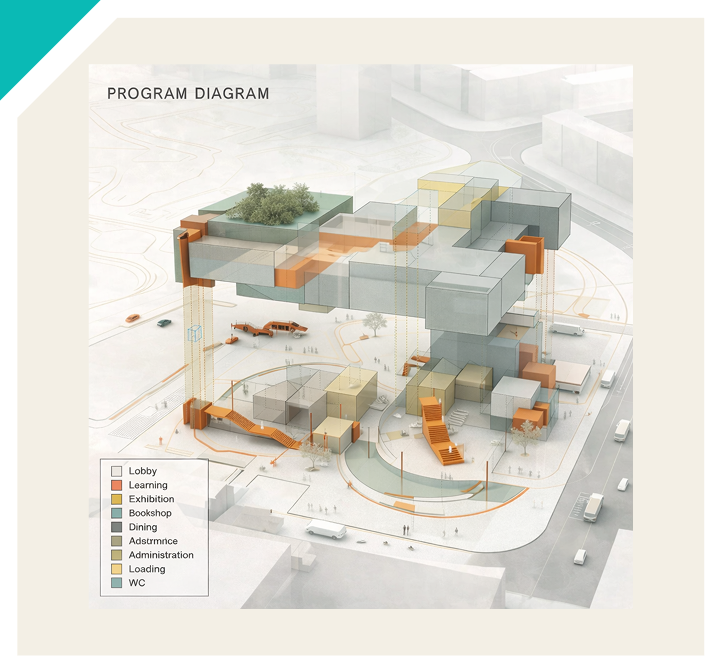
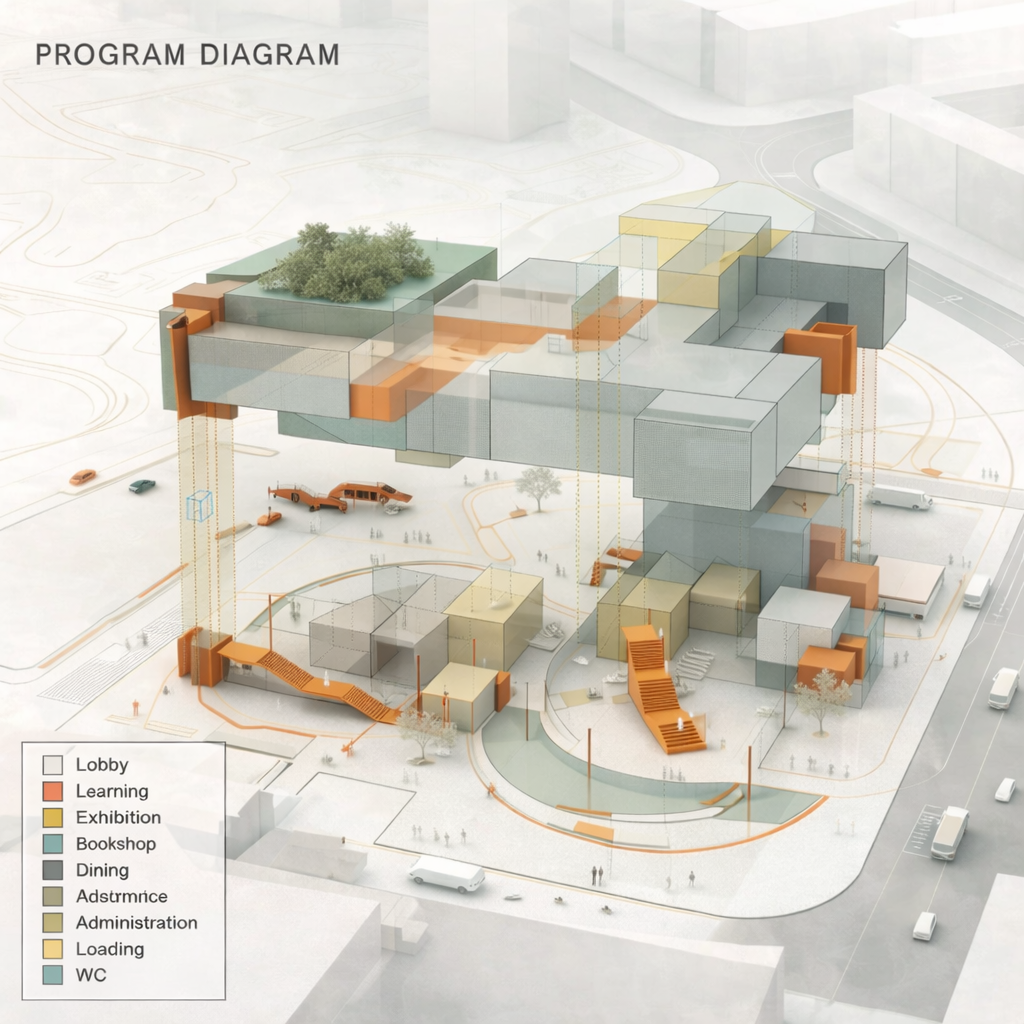
Mixed-use projects introduce complexity because multiple building types must function together — each with different constraints, schedules, and operational needs.
Conflicts typically emerge late when independent systems intersect.
We organize mixed-use design around relationships between components from the beginning: circulation, vertical stacking, structural transitions, parking distribution, and service separation.
Instead of resolving conflicts later, we model the interactions early.
What this enables:
Clear separation of public and private flows
Early resolution of structural transfer conditions
Coordinated parking and loading strategies across uses
Predictable progression into documentation despite complexity
Mixed-use success comes from integration — not layering programs on top of each other.
Industrial projects prioritize clarity, speed, and scalability. When building systems are repeatable and performance-driven, structured workflows create momentum.
Our process supports rapid feasibility testing and efficient adaptation of building footprints to varying site conditions. By working within coordinated parameters, we ensure design continuity from early test fits to fully developed architectural models with minimal friction.
This structured approach allows industrial projects to maintain delivery momentum while preserving design control and documentation integrity.
What differentiates our approach:
• Rapid test-fit evaluation aligned with site constraints
• Parametric-driven models adaptable across multiple sites
• Seamless transition from feasibility to detailed model development
• Documentation workflows structured for accelerated delivery
• Repeatable systems without sacrificing architectural intent
In data center development, performance metrics drive design. The most critical variables are data hall density — and that value should be visible across the model, not inferred after the fact.
Our workflows provide live feedback on density, spatial efficiency, and coordination impacts as the design evolves, allowing teams to move quickly without losing performance visibility.
What differentiates our approach:
• Real-time simulation of data hall density during iteration
• Design workflows aligned with speed-to-delivery
• Early integration with structural and MEP systems
• Documentation structured for phased and scalable deployments
• Experience supporting teams engaged with developers such as QTS, Iron Mountain, and CyrusOne
We focus on measurable performance — not assumptions — while maintaining the pace required in mission-critical environments.
Parking structures require precision early — but they also demand speed. Iteration, and documentation depth.
Our workflows evaluate structural depth, column logic, and clearance conditions during schematic design, allowing coordination decisions to inform the architecture from the outset. At the same time, our design-to-documentation process transitions models into construction-ready systems, reducing friction as the project advances.
This structure allows more time where it matters — refining circulation logic, facade studies, and opening strategies — without delaying delivery.
What differentiates our approach:
• Early integration of structural and clearance parameters
• Design-to-documentation workflows that streamline production
• Capacity for iterative facade and opening studies
• Reduced downstream coordination adjustments
• Documentation structured for smooth progression through SD, DD, and CD
We approach parking structures as coordinated, performance-driven systems — balancing precision, iteration, and delivery momentum.